


Developers Negotiate Terms. Sellers Negotiate Price.
In the same city, over the same three months, Israel's housing market moved in two opposite directions. In Tel Aviv, new-build sales jumped 35% between March and May 2026 — while resale transactions fell 37.5%. Ashdod was even starker: new construction up 115.6%, resale down 7.6%. That's not one market with two speeds. It's two different markets sharing the same streets.
The obvious read is "buy new — that's where the momentum is." But momentum and leverage are not the same thing. Look at why each side of the market is moving the way it is, and the better opportunity right now may be sitting on the quiet side.
What the numbers actually say
According to Israel's Central Bureau of Statistics, about 21,390 apartments were sold nationwide between March and May 2026, down 10.6% from the previous three months. New-build sales rose 0.4% — and once you adjust for seasonality, they jumped more than 20%. Resale transactions fell 17.2% over the same stretch and were down 13.7% from a year earlier.
Part of the reason new-build is holding up is simple: developers have a lot to sell. About 84,130 new apartments were still sitting unsold at the end of May — roughly 29 months of supply at the current sales pace. Nearly two and a half years of inventory is pushing developers to move product however they can.
The slowdown in resale wasn't uniform, but it reached every major city measured — including Jerusalem, the country's largest resale market at 847 transactions, down 16.3%:
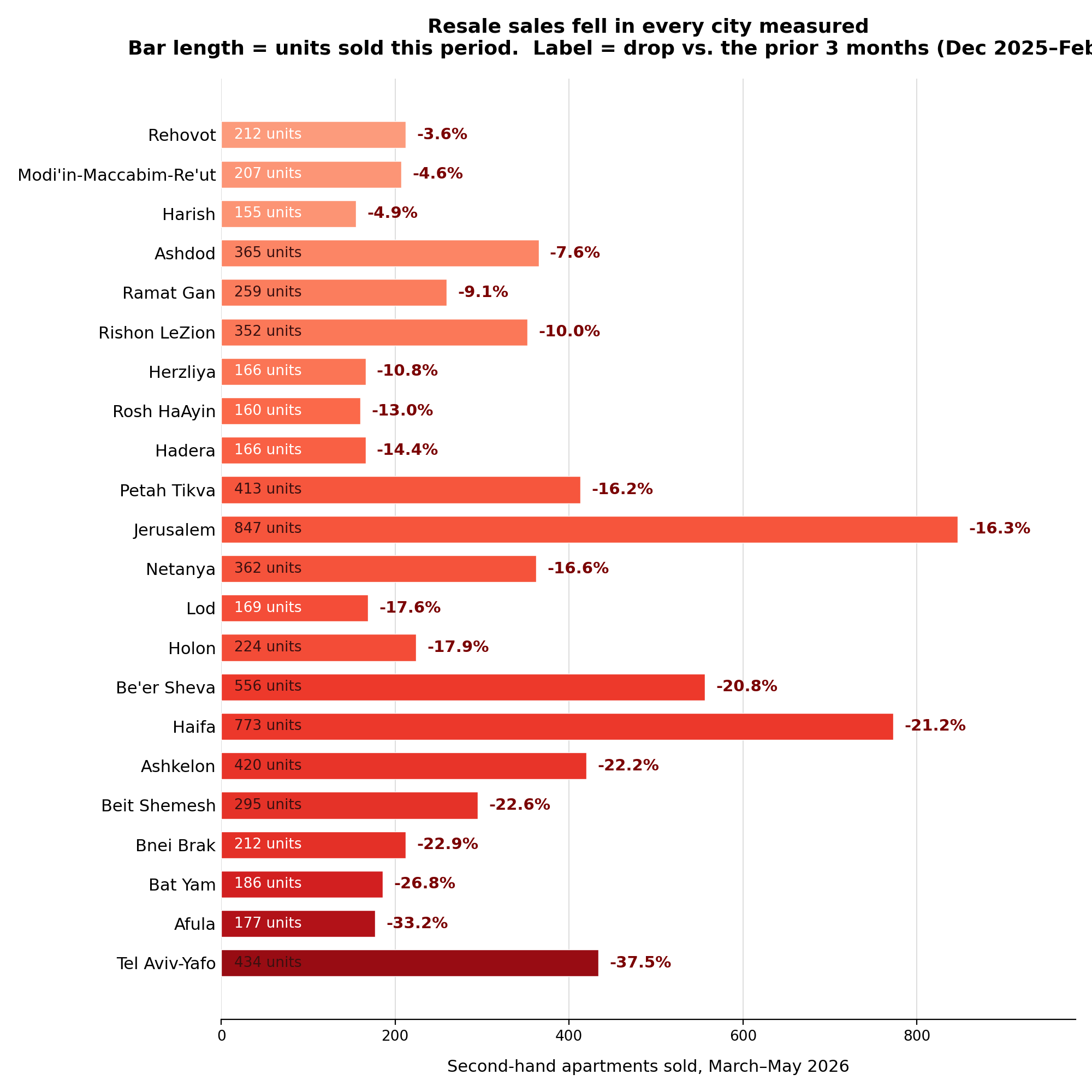
Resale transactions by city, March–May 2026. Source: Israel Central Bureau of Statistics, as reported by Ynet (July 14, 2026).
Two markets in the same cities
Put new-build sales next to resale in the ten largest markets and the picture flips. Resale fell everywhere; new-build climbed in most of the same cities, pushed along by developer financing incentives and government-subsidized programs steering buyers toward new inventory.
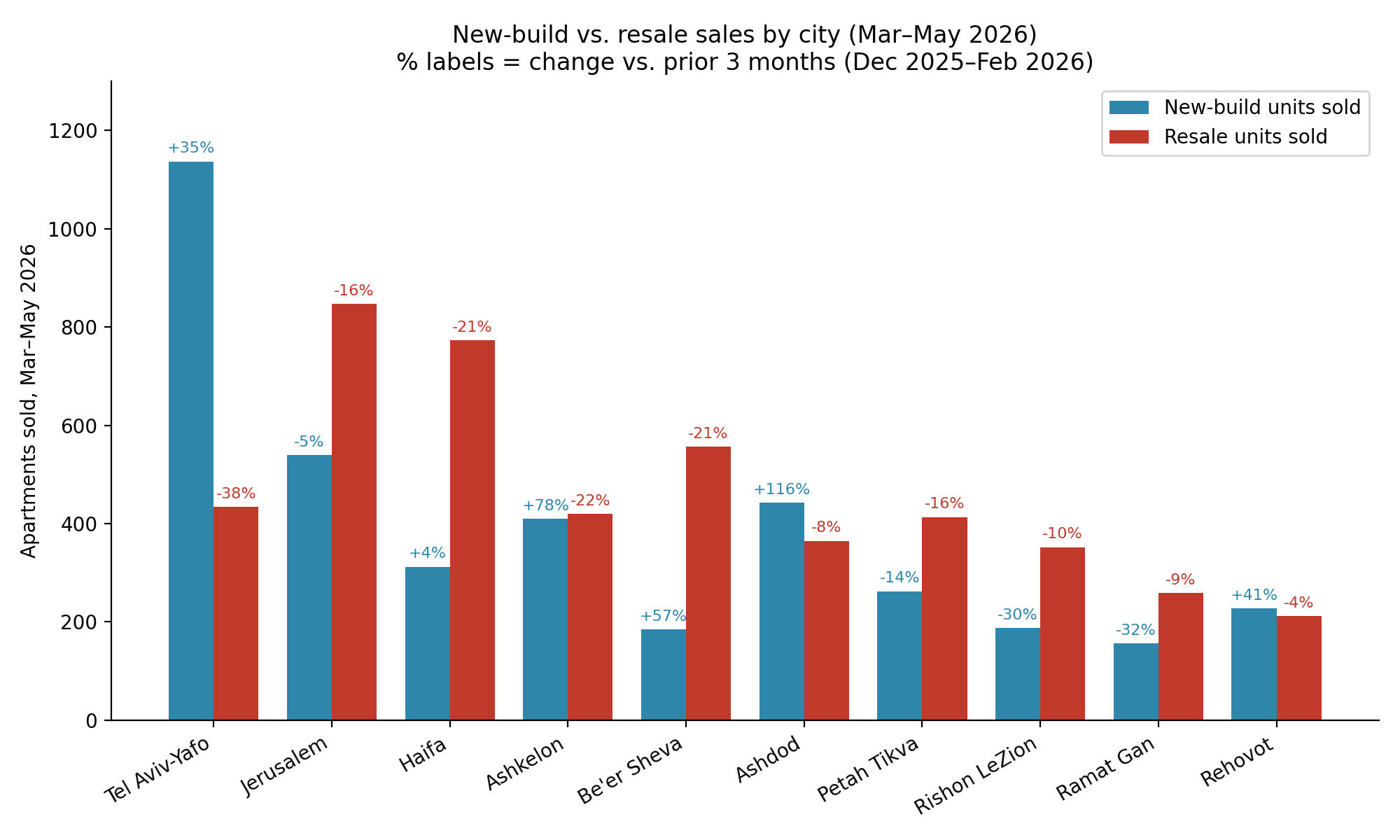
New-build vs. resale sales, 10 large cities, March–May 2026 vs. prior three months. Source: Israel Central Bureau of Statistics, via Ynet, July 14, 2026.
Ashkelon: new-build up 78.3% against a 22.2% drop in resale. Ashdod: up 115.6% against a 7.6% drop. And Tel Aviv holds the widest split of all — new-build up 35% in the same three months resale fell 37.5%. Two different markets, moving in opposite directions.
Why momentum isn't the same as value
It's tempting to see rising new-build sales and assume that's where the value is. But a good chunk of that increase is developers working down unsold inventory with incentives. A developer who needs to move product isn't necessarily giving you a better price — they're usually packaging the same price more attractively: extended payment schedules, subsidized rates, upgrades thrown in.
One note for buyers paying in dollars, pounds, or euros: stretching payments over several years also stretches your exchange-rate exposure. That works in your favor if the shekel weakens against your currency before the final payments — and against you if it strengthens. It's a variable to plan around, not a bonus to count on.
Meanwhile, the resale market is quieter — but quiet doesn't mean closed. Some of those sellers have real reasons to get a deal done, and that's worth a closer look before assuming new construction is the obvious move.
The seller with a deadline
This applies to a specific kind of seller, not every listing — but in a slow market it's common enough to matter. Consider the owner who already bought their next home. Under Israeli law, buying a new home before selling your existing one initially triggers the higher "additional apartment" purchase tax (Mas Rechisha). Sell the first home within the required window and you can usually reclaim the difference; miss the deadline and the higher tax applies retroactively — plus interest and linkage. That clock creates genuine motivation to close, even at a lower number.
We watched this play out recently in Jerusalem's German Colony. We represented a large garden apartment whose owner had already purchased their next home and was closing in on the two-year window — miss it, and they would owe the difference between the reduced purchase-tax rate they'd paid and the 8% additional-apartment rate. With the deadline approaching, they were willing to come down close to 20% from their asking price. The buyers — an American family who'd been searching for exactly this kind of home — got a number no developer in the city could have printed. The deadline did the negotiating.
Tax deadlines are only one version of it. Some sellers need the proceeds for another purchase, to reduce debt, to settle an estate, or to stop carrying a vacant apartment that costs money every month. In a slower market these situations multiply — and these are the sellers who negotiate seriously. The real question is never first-hand versus second-hand. It's whether the person selling has a genuine reason to get a deal done. Developers, whatever incentives they offer, are rarely under that kind of personal pressure.
What you see is what you get
With a resale apartment you're buying a finished, existing home. You can walk through it, bring an inspector, check the building and the neighbors, and know exactly what you're getting before you commit. Every home needs maintenance eventually — but with resale, the issues are visible up front instead of living in floor plans and renderings.
New construction adds a different layer: the risk that the developer finishes the project, stays financially stable, and delivers on time. That risk is real in Israel today — contractor failures have risen sharply in recent years, which is precisely why the law requires developers to give buyers Sale Law guarantees (Arvut Chok Mecher) protecting deposits if a project collapses. The protection matters; so does what it tells you about why it exists.
The discount developers usually can't give
Instinct says a developer sitting on unsold units should be an easy negotiation. In practice it's often the reverse — because banks are effectively partners in almost every construction project in Israel. Construction financing is approved against a feasibility report projecting what units will sell for, and financing agreements typically require the bank's sign-off before the developer drops prices below projection. Cutting the official price can also force a revaluation of every unit already sold — which can trip the loan's own covenants. A real discount off the listed price usually has to clear the bank, not just the sales office.
What has loosened is everything around the price. One Israeli developer recently ran a promotion built entirely on free upgrades — air conditioning, a kitchen renovation, worth roughly ₪700,000 — without touching the sticker price. That's the industry playbook right now: 10/90 and 20/80 payment plans with no index linkage, subsidized mortgage rates, and, in some Jerusalem and Tel Aviv projects, arrangements that let buyers move in and live in the apartment for a few years before completing payment. Treasury data from May 2026 showed about one in five free-market developer sales included a financing benefit of this kind.
Bank of Israel restrictions issued in March 2025 — running through the end of 2026 — were meant to rein in the riskier versions, capping subsidized balloon loans at 10% of a bank's mortgage lending. Reporting through late 2025 found incentives had already climbed back toward pre-restriction levels. Either way, the underlying logic holds: on new construction you negotiate the terms; on resale you negotiate the price.
When the incentive almost won
How tempting are those terms in practice? Tempting enough to nearly undo a signed-and-sealed retirement plan. We recently sold an apartment near Baka to a couple in their seventies who had searched carefully for the right home for this chapter of their lives. Days before signing, they nearly walked away — a new project at Jerusalem's southern edge was offering 15% down with the keys at possession, meaning they could rent the apartment out for two years before paying the remaining 85%. As incentives go, that one is about as aggressive as this market gets.
What the payment plan couldn't change was the location. Once we walked through the difference — the neighborhood they'd actually live in, the streets they'd walk every day, what each address would mean at resale — they chose the existing home. That's the pattern worth noticing: the more aggressive the financing, the harder it's working to make up for something the property itself can't offer. Incentives are strongest where the asset is weakest.
So — first-hand or second-hand?
New construction fits the buyer who'd rather not tie up all their cash at once, is comfortable spreading payments over three to five years, and doesn't mind waiting to move in. If that's you, this is a genuinely good moment to shop: developers are motivated, terms are unusually flexible, and there's competition for your business. Expect to still pay a real premium for the new-construction label in sought-after projects.
An existing apartment fits the buyer who wants to move in now, doesn't want their money exposed to a developer's balance sheet or construction schedule, and wants to see exactly what they're buying. If you're risk-averse or your timeline is short, resale is the steadier path — and the sellers most worth finding are the ones with a real deadline, like the upgraders on the purchase-tax clock.
Neither path is objectively right. It comes down to timeline, appetite for risk, and how you want your cash flow to work. But the data suggests the popular read — that new construction is where the deal is because that's where the activity is — undersells how much real, quieter room to negotiate exists on the resale side today. (As always, this is general market information, not personal financial, tax, or legal advice.)
What to watch next
Two things will tell us whether this split narrows: whether unsold inventory keeps edging down from its winter peak, and what happens to financing incentives as the Bank of Israel's restrictions approach their end-2026 expiry. The next CBS release will show whether resale volume finds its floor.
Gabai Real Estate is a boutique Anglo-Israeli agency serving over 3,000 Anglo and Israeli buyers across Jerusalem, Efrat, Ma'ale Adumim, and communities throughout Israel. We follow the official data so our clients don't have to — and we read it with the benefit of what we see on the ground, deal by deal. If you're weighing a move anywhere in Israel, it helps to read the data with someone who knows the ground — that's a conversation we're always happy to have.


